
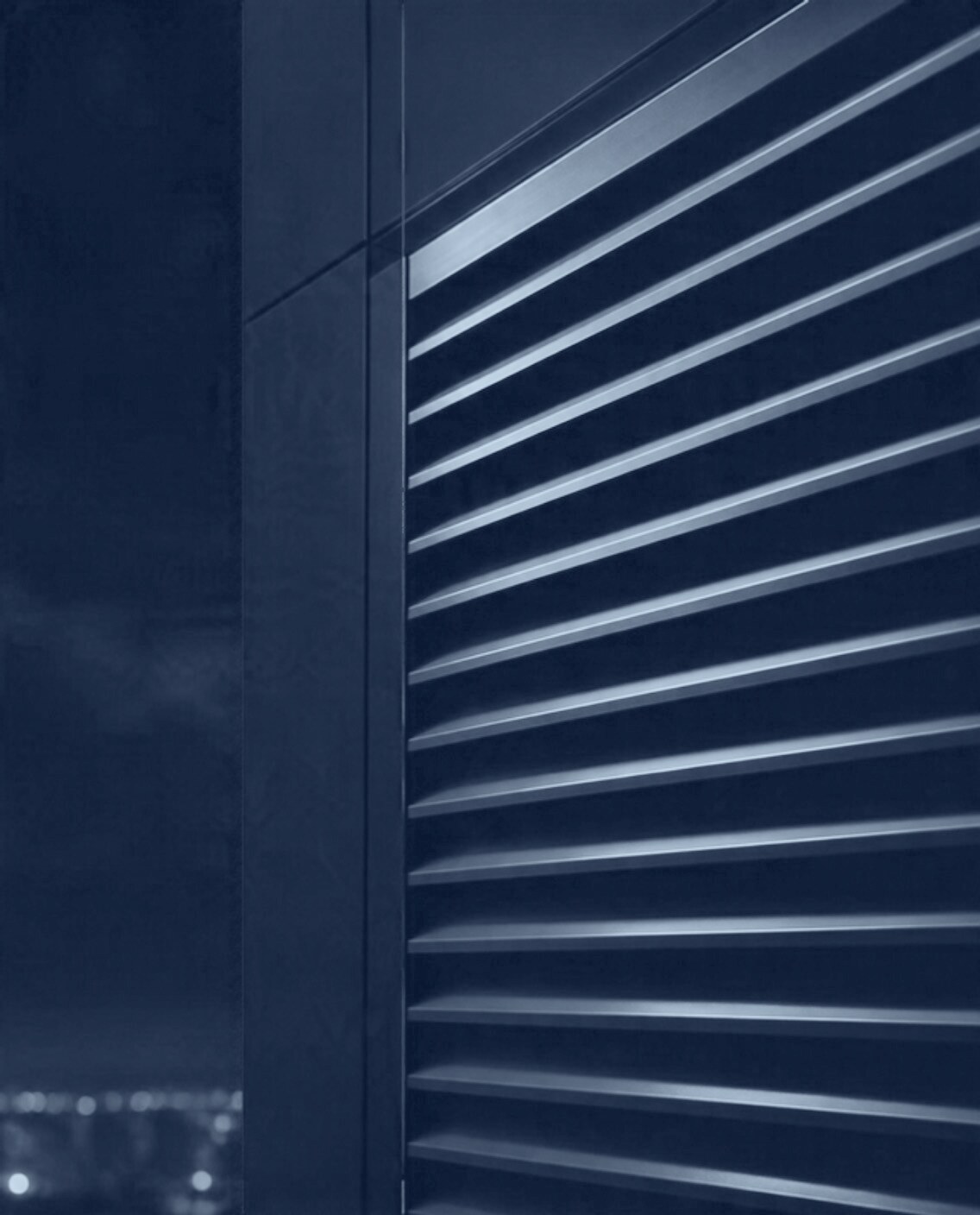
Every fresh air intake, generator room and car park vent eventually becomes a weather louver question: how much air passes through, and how much rain comes with it. Standard blades shed the rain that falls on them. Drainable blades go further: each blade carries a channel that catches wind-driven water and walks it out of the frame before it can enter the plenum. On the coast, drainable is not an upgrade, it is the baseline.
The second decision is what else the louver keeps out. Insect mesh for plant rooms, bird mesh for anything at height, sand screens for sites that face dust storms. Every screen costs free area, the open fraction that lets air through, and free area lost is fan power spent. We publish the pressure drop for each combination so your mechanical engineer is not guessing.
When a louver scales up to an architectural facade, two more things start to matter: structural framing that survives monsoon gusts without racking, and acoustic blade options that keep generator noise inside the property line. Both are solved in the extrusion die, which is why we make our own. A louver is the one product on a building that is simultaneously HVAC, envelope and architecture, and it deserves to be engineered as all three.